Recurrent novae in M31
Colloquium at Ball State University, October 30, 2025.
Astronomer at San Diego State University and Mount Laguna Observatory. I study novae, stars that suddenly erupt, in our own galaxy and in our neighbors such as Andromeda.

The flaring star in this field repeats like a recurrent nova: same star, eruption after eruption.
Background: NSF–DOE Vera C. Rubin Observatory
My research centers on cataclysmic variable stars: novae, dwarf novae, and nova-like variables. These are close binaries in which a white dwarf pulls gas from a companion star, sometimes until the accumulated layer ignites in a thermonuclear eruption.
I work on two scales. Within the Milky Way, I study the fundamental properties of individual systems. Beyond it, I study how novae are distributed and how common they are in nearby galaxies, especially M31, the Andromeda Galaxy.
My 1983 doctoral thesis, On the Masses of White Dwarfs in Cataclysmic Binaries, is available as a PDF.

Living catalogs of novae in the Local Group, extended from the earlier MPE nova catalogs and kept up to date as new eruptions are found.
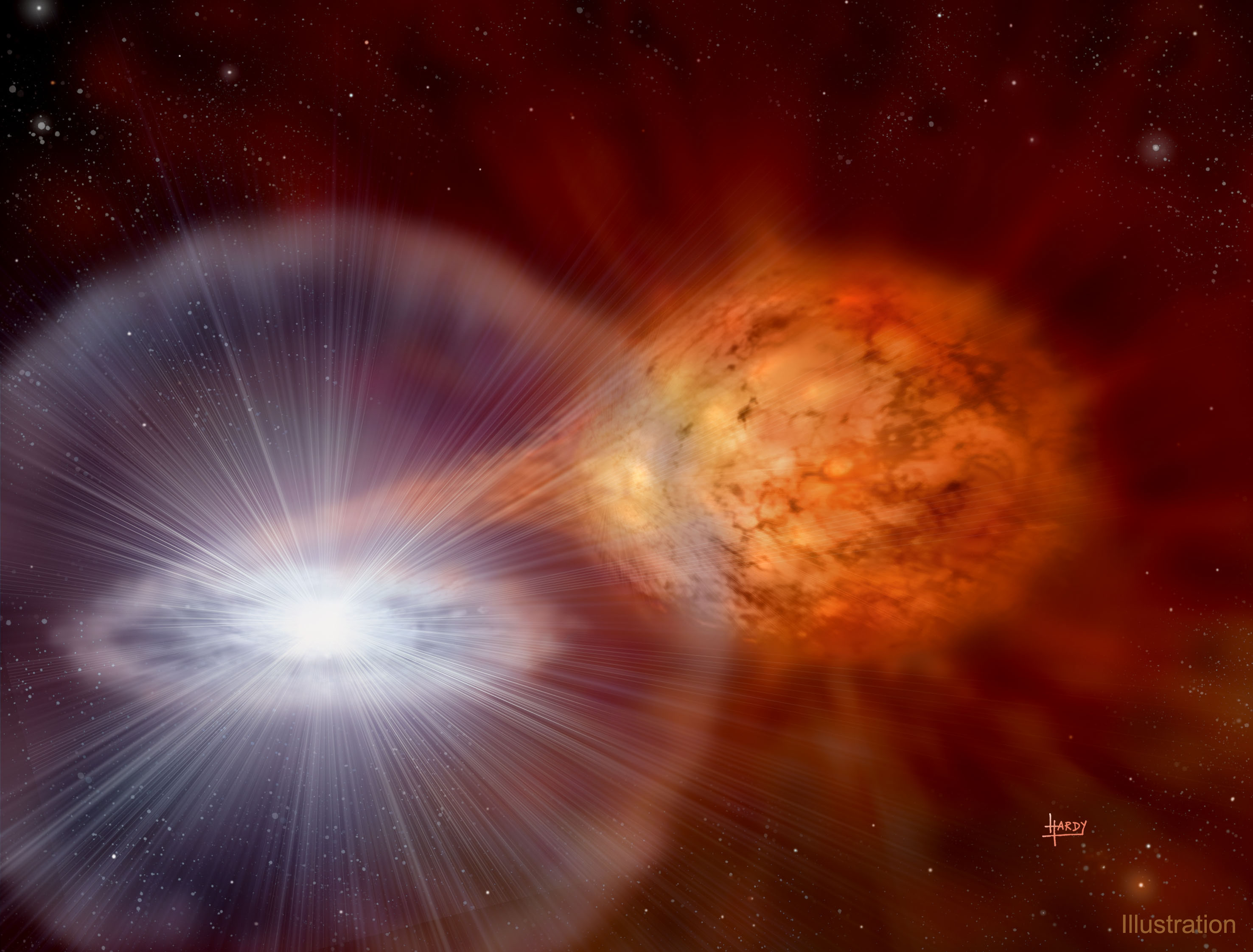
This nova in Andromeda erupts about once a year. Over many eruptions it has blown out a vast “super-remnant,” seen as an arc of gas beside it.
Our group's work on the remnant was featured by SDSU NewsCenter. See also my list of recurrent novae in M31.


A Historical Perspective
My book on novae beyond our own galaxy: how they are found, what their numbers and locations say about the galaxies they live in, and what they teach us about the binaries that produce them.
Colloquium at Ball State University, October 30, 2025.
A talk for a general audience.
An author and scientific editor interview for AAS Journals. There's also a related post from the AAS.
I led the effort to secure a $750,000 gift from the estate of Phillips Claud, Jr. for a new 1.25-meter telescope at Mount Laguna Observatory.
Before astronomy, and alongside it: freight trains, mountains, and a minor planet.
The San Diego Union-Tribune ran a “10 Things” story about my early years, including hopping freight trains across the West.
